
When someone is in mental health treatment, they may wonder what recovery looks like. Is it the absence of symptoms, or something more?
Rogers Behavioral Health’s Drew Dyrssen, LPC, clinical supervisor at Rogers’ Silver Lake Outpatient Center, closes out our “Clearing Up Confusion about Mental Health” series by addressing three common misconceptions and explaining what recovery truly means.
How do you define recovery?
Recovery isn’t the absence of painful thoughts or feelings. It’s about accepting them and working with them in any given situation. No mental health treatment can permanently remove the difficult thoughts, feelings, sensations, or urges we experience internally.
Recovery is about choosing behaviors that move us toward what truly matters most in our lives. We make those choices moment by moment.
Recovery means bringing awareness to our internal experiences, courageously choosing behaviors that help us accomplish our goals in everyday life, and doing so with self-compassion. There isn’t a perfect way to go about this, so we need to be flexible and adapt if something doesn’t work out the way we thought it would.
What are some common misconceptions about mental health recovery?
Three common misconceptions about recovery are:
1. Recovery means you’ll never struggle again.
When we talk about recovery, it’s easy to imagine it as the complete erasure of pain, trauma, or difficult thoughts and feelings. But recovery is less about eliminating those experiences and more about changing how we relate to them. Our minds want to make sense of things, so it will link events with emotions and the labels we give ourselves. The way we respond to a thought can become a pattern that’s hard to break. We can get stuck in a loop of behaviors that take us away from our values or cause us harm. Recovery means being able to notice these patterns and increase our awareness and flexibility of how we respond.
2. Recovery doesn’t mean relapse.
With this recovery mindset, we can view relapse as a response to circumstances at a particular time that is separate from the person. In other words, relapse is something that occurs as part of being human. It doesn’t define who you are. Relapse is a return to old thought patterns and behavior choices that were unhelpful for a variety of reasons. For example, some of those previous behaviors didn’t align with your values, were focused on short-term relief at the cost of your long-term goals, or were motivated by social pressure, avoidance, or being stubborn and choosing to do something because that’s what you’ve always done.
Returning to old patterns is common and makes sense. It takes time and practice to act on new and more flexible ways of responding. Therefore, the goal is to reframe relapse in a way that promotes continued progression toward what truly matters most in your life.
3. Recovery means any setbacks erase your progress and you’re back at square one.
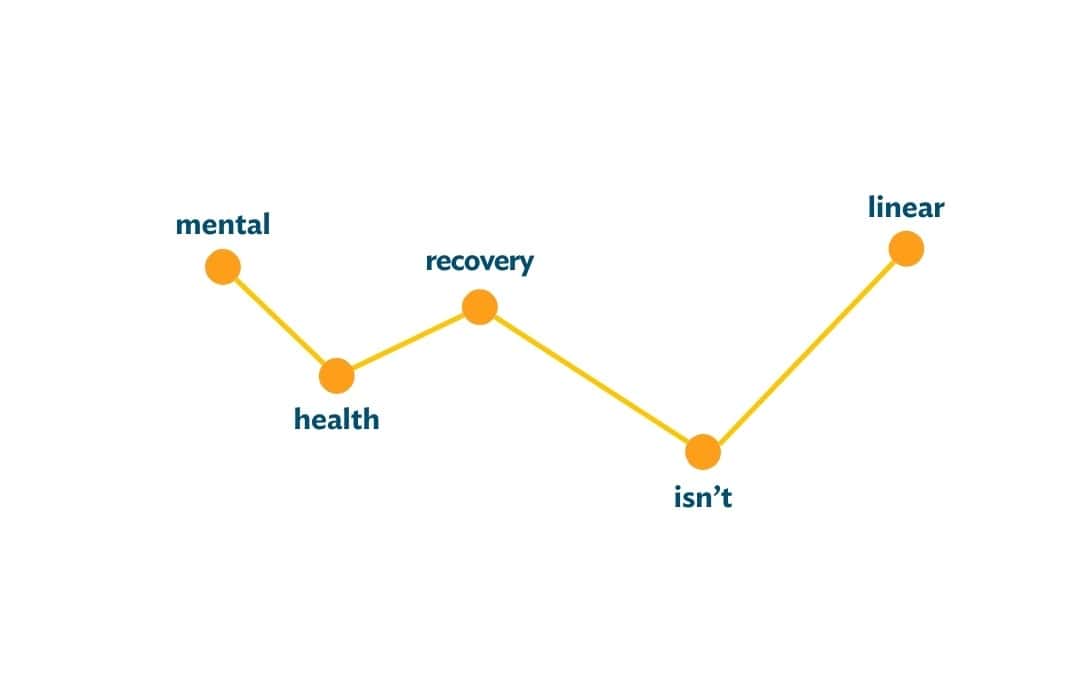
Everyone experiences their recovery journeys differently. Very rarely is it a smooth, steady progression. More often than not, it’s a bumpy ride full of ups and downs and twists and turns. It’s important to remember that these experiences are opportunities to practice using the skills you learned in treatment in real time. A relapse doesn’t set you back to square one. It simply provides information you can learn from and make choices about.
This is especially true with forms of cognitive behavioral therapy. Most people report feeling their symptoms increase in the beginning of treatment. This is due to confronting situations that they’ve previously avoided. It takes a lot of courage to experience something fully. It’s common for someone to feel their progress fluctuating when they’re doing exposure and response prevention therapy because over time, a person is gradually exposed to things they’ve been avoiding.
 Progress is also multi-faceted and can have multiple meanings. You could be progressing in one area, like being able to function better at work, but notice that your anxiety-based thoughts are more challenging at the same time. Holding space for both things to be true can be challenging. A struggle in and of itself doesn’t mean you’ve suffered a “setback.”
Because treatment progress is not linear, it can be helpful to accept the ups and downs of recovery.
How does a person maintain recovery?
Maintaining recovery is a daily, moment-by moment choice in every situation. Having clear goals and values will act as a compass to guide your choices. While bringing mindful attention to our thoughts, feelings, and urges to act, we give our best attempt to move in a direction that supports our values. Things don’t always work out the way we planned, but the attempt is gold! Maintaining recovery means being mindful of the present moment, accepting our internal stuff (thoughts, feelings, urges, emotions, etc.), taking action, and using the necessary skills to do so.
How can family and loved ones support a person’s recovery?
Friends and family can help the person seeking therapy by first and foremost cultivating an environment that supports valued actions. Oftentimes, that’s as simple as showing up and being present.
At Rogers, loved ones are often invited to therapy sessions to be part of the healing process. Alongside the person in treatment and their primary therapist, they work together on topics that support recovery.
What words of encouragement would you have for someone in mental health recovery?
Much of the way we think and act is influenced by our learning history, meaning, things that have been reinforced in us over time. Eventually, we start to become those difficult thoughts and feelings. Without help, our entire identity may become fused with trauma, depression, anxiety, etc. Recovery is about taking a more self-compassionate posture, noticing what is present within us in the moment, and choosing the action that seems to be a step in the right direction in any given situation. And, since human beings are generally social creatures, it makes sense to do all this work surrounded by a group of people who are supportive and want to see you living your best life full of what matters the most to you.
Rogers offers mental health treatment
Making the decision to receive mental health treatment isn’t easy, but it can change your life.
We’ll be here when you’re ready. Call 833-308-5887 for a free, confidential screening.
