
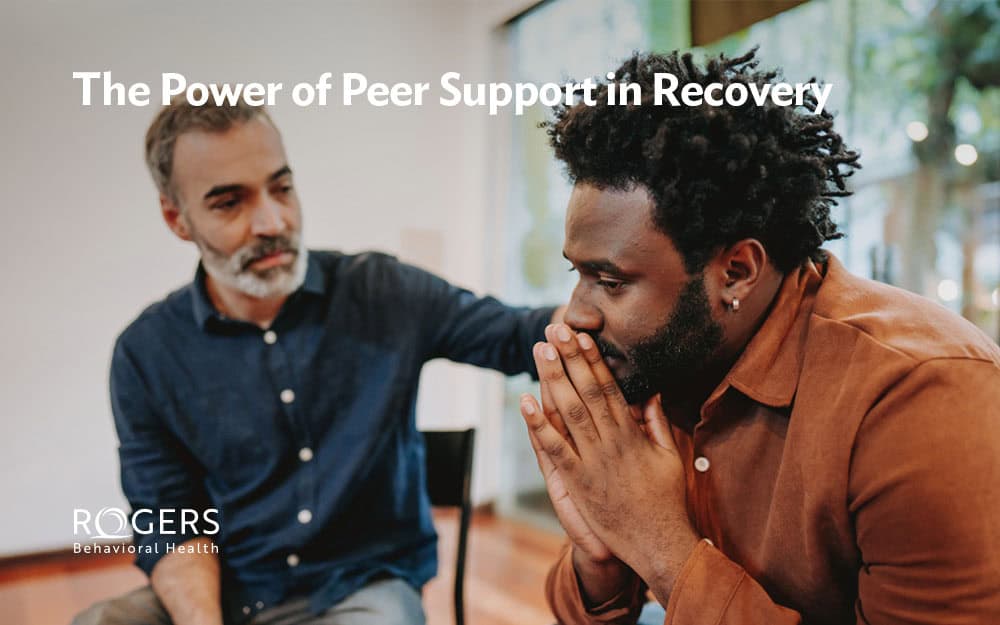
Having someone who understands what you’re going through can make a big difference in substance use recovery.
Rogers Behavioral Health’s Stephanie Henckel, recovery peer specialist, explains how shared lived experience, connection, and encouragement can empower people throughout their recovery journey.
What is a recovery peer or support specialist?
As a recovery peer specialist (RPS), it’s a privilege to support people as they navigate their recovery journey. I come alongside them as a confidant, partner, and an ally. I’ve been there and I get it.
My job isn’t to tell someone what to do or pretend that I have all the answers. Recovery peer or support specialists guide, encourage, listen, and support.
Our goal is to empower people in treatment to find and trust that inner knowing of what is best for them. We’re willing to share our lived experience strategically, when it’s helpful, to inspire, offer hope, or provide another perspective. Ultimately, it isn’t about us. We aren’t gurus or experts. We are simply people who care and genuinely want to help people work through their thoughts so they can find the answers within themselves.
Peer support also means advocating for the patient’s voice, choices, needs, and goals. We believe in “nothing about you without you.” Recovery should not be decided for someone. Everyone should be an active participant in every part of their recovery.
How is a recovery support specialist different from a therapist or counselor?
We don’t advise or counsel. As a matter of fact, our role is specifically rooted in the concept of mutuality. We want the people we work with to know that we are equals—as two people in recovery—regardless of all other aspects of our lives, including education, class, age, and professional status.
Therapists and counselors play a foundational role in a person’s recovery. Recovery peer specialists complement their work by providing an environment in which people may feel a little less guarded or more willing to share certain perspectives. If the therapist or counselor is the director of the play, we’re the stagehand there to prompt the patient, who is the main actor, with their lines or offer them a glass of water to drink.
How can peer support help during recovery?
The role we play can vary greatly depending on the patient, which is true to Rogers’ person-centered treatment approach. We can be especially helpful at times when someone is experiencing doubts or feelings of disconnection. That happens often at the beginning of the recovery journey but can certainly resurface throughout the process.
Building confidence early in recovery
Recovery peer specialists often come in at the beginning of a person’s recovery journey, when they may be feeling the most overwhelmed, judged, alone, and lacking confidence. Some people carry a lot of shame around aspects of their past and fear opening up to a mental health professional. Connecting with someone else in recovery can really help reduce that tension, and people may lower their walls more easily. Deciding to commit can often be one of the biggest hurdles of recovery. For someone early in the process, an RPS can help with building the confidence a person needs to take that first step.
Providing support throughout recovery
Throughout recovery, an RPS can offer a comforting presence due to the relatability and familiarity of shared lived experience. In times of greater uncertainty, self-doubt, or feeling misunderstood, I think that can be a really valuable missing piece that helps keep a person’s momentum going throughout treatment.
Why does shared lived experience matter in recovery?
As people in recovery, we can easily find ourselves swallowed up in shame over our past indiscretions. We put a lot of pressure on ourselves to prove to the world and to ourselves who we really are and what we’re capable of. That shame can lead to a deep sense of disconnection. We feel like everyone is judging us. We internalize that judgment, slowly condemning ourselves as “not good enough” for the rest of the world.
Seeing qualities we admire in another person with lived experience challenges the belief that our disease defines us or that our identity and capabilities are somehow diminished. We are often so much harder on ourselves than we are on others. By having someone with shared lived experience by our side, we’re encouraged to give ourselves grace. If we aren’t judging them negatively, then perhaps we shouldn’t judge ourselves that way either. I think that seeing this, we begin freeing ourselves from the self-imposed box we place ourselves in—a box that can be incredibly limiting and isolating.
What are some common challenges people face after completing treatment?
Four common challenges people face include:
1. Navigating transitions: I think transitions can be the hardest part. Beginning recovery is a huge change. It involves letting go of the familiar forms of escape we thought we needed for so long. But even after that, there are more transitions as a person steps down in care and eventually leaves treatment.
2. Maintaining positive changes: While in treatment, a person begins rebuilding new social supports, routines, and perspectives, and there’s a lot of encouragement to keep these changes in place. But after treatment, they need to set all the working pieces in motion and try to function in their new life like a well-oiled machine. If you can imagine, as a person new in recovery just discharged from treatment, it’s easy to see how it can be very tempting to fall back into old patterns. They need to commit to this new lifestyle and make sure it sticks, facing obstacles as they arise with the new, healthy methods learned in treatment, while resisting old destructive responses.
3. Building social support: Having positive social support is critical to sustaining sobriety and maintaining momentum in recovery. Friendships take time to build, and we may need to continually challenge any thoughts or beliefs that get in the way. Automatic thoughts about social situations and beliefs surrounding shame and self-stigma may need to be continuously monitored, examined, and processed to overcome barriers to forming meaningful, healthy relationships.
4. Finding passion: Discovering hobbies and interests that we find meaningful and fulfilling helps us create that “life worth living” that is often touted in the recovery world as the pinnacle for which we should strive. Many of us who have been in long-term addiction may have never known such passion. Those who have known it likely lost touch with it along the way. When we are just fighting to stay sober, sometimes fulfilling our passions seems like a luxury. Accomplishing the daily tasks of surviving and adulting can feel like noteworthy accomplishments, and they are! But I think we underestimate the value of passion in our lives.
Peer support reminds us that recovery is possible and that no one has to navigate it alone.
Rogers offers substance use treatment
Rogers provides individualized substance use treatment for teens and adults. We know how important it is to address addiction and mental health challenges at the same time, and we do so with care and compassion.
Taking the first step can be scary, but it can lead to a healthier, more meaningful life. Call 833-308-5887 for a free, confidential screening.
A recovery peer specialist is someone with lived experience of recovery who supports others through connection, encouragement, listening, and guidance.
Recovery peer specialists do not provide counseling or advice. Instead, they draw on their lived experience to offer support and connection as an equal partner in recovery.
Connecting with someone who has been through recovery can reduce feelings of isolation and shame and help people see that their past does not define who they are or what they can accomplish.
A person can work with a recovery peer specialist at any point in their recovery. Peer support may be especially helpful early in recovery, during transitions in treatment, or when someone is experiencing self-doubt or disconnection.
