
The human mind is full of mysteries, but it also holds the keys to solving them. While decades of research have shown that effective mental health treatment can improve symptoms, much remains unknown about what happens inside the brain during recovery. By uncovering those answers, researchers hope to better understand how treatment works and ultimately improve care for future patients.
At Rogers Research Center, Jeff Engelmann, PhD, research psychologist, is working to do just that through the use of electroencephalography, or EEG.
“The EEG stands for electroencephalogram, so it’s basically a reliable, valid, and non-invasive measure of human brain activity,” Dr. Engelmann said.
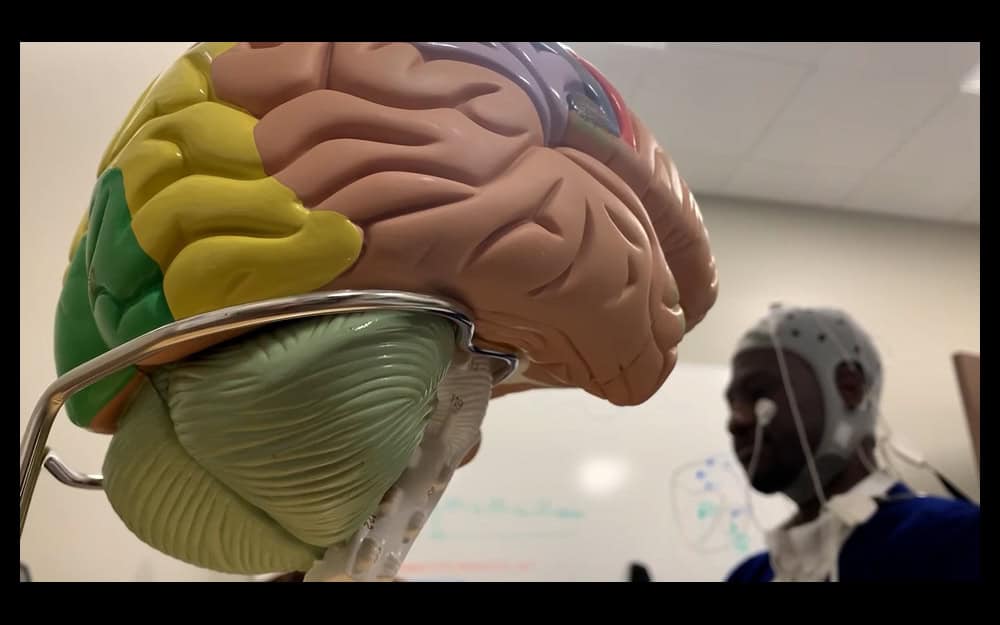
Using a cap fitted with electrodes, EEG allows researchers to measure electrical activity across different regions of the brain. At Rogers, researchers are using the technology to explore a fundamental question: Does effective treatment result in measurable changes in brain activity?
To learn more, read on and watch the video below.
Looking Beyond Symptoms
Exposure and Response Prevention (ERP) therapy is widely recognized as an effective treatment for obsessive compulsive disorder (OCD), helping individuals gradually face their fears and tolerate distress. Building on that foundation, Rogers researchers are examining whether intensive OCD treatment is also associated with measurable changes in the brain.
“This is the first time we’re really looking at this in a severe population who is seeking residential treatment for OCD,” Dr. Engelmann said.
To better understand what happens in the brain during treatment, Dr. Engelmann is leading an EEG study involving Rogers patients who volunteer to participate in the research.
Participants complete a challenging computer task designed to produce both correct and incorrect responses while researchers record brain activity.
“They complete a challenging task on the computer,” Dr. Engelmann explained. “They’re just identifying which direction arrows are pointed on the screen, but they go by really quickly. And the task is designed so people get some trials correct, some trials incorrect.”
One of the measures researchers can examine is how the brain responds to mistakes.
“It’s very well known that people with OCD and anxiety have an exaggerated error-related negativity response compared to healthy control population,” Dr. Engelmann said. “But the impacts of treatment on that biomarker are much less studied.”
Measuring Recovery in New Ways
The study explores whether the effects of intensive OCD treatment extend beyond observable symptom improvement to measurable changes in brain activity.
“If we know that treatment is changing that region, we can perhaps develop better treatments targeting that region more specifically,” Dr. Engelmann said.
The research may also provide additional clues about whether treatment is working and help researchers detect subtle changes that traditional assessments might miss.
“Our primary measure is always going to be how people say they feel, but sort of as an added metric to help maybe detect subtle changes that we can’t pick up with our standard measures,” Dr. Engelmann said.
Early findings from the study suggest that OCD treatment may not only improve symptoms but may also be associated with measurable changes in brain activity as treatment progresses. As researchers continue to learn more about those changes, the findings could help deepen understanding of recovery and inform future treatment approaches.
Turning Questions Into Answers
For Dr. Engelmann, research offers the opportunity to combine scientific discovery with direct patient impact, transforming our minds from a mystery into a solution.
“These technical studies like the EEG study allow me to do both things that I enjoy, both helping patients and trying to create better outcomes, but also being able to solve technical puzzles and challenges,” he said.
