
We’re surrounded by confusing and incorrect messages about mental health. It can be difficult to know what’s accurate and what isn’t.
In our series, Clearing Up Confusion About Mental Health, we’ll explore:
- What evidence-based treatment truly means
- Why medication can be helpful
- How pop culture often blurs the lines between fact and fiction
- What recovery really looks like
Our goal is to give you the facts you need to feel confident as you seek treatment for yourself or support your loved one.
Rogers Behavioral Health’s Dr. Adrianne McCullars, PhD, licensed clinical psychologist and vice president of clinical services, explains what evidence-based treatment is and why you can trust it.
What does “evidence-based” mean when it comes to mental health treatment?
When we say we use evidence-based treatments in our mental health and addiction care, we mean our approaches are supported by credible scientific research. That means they:
- Have been carefully studied
- Consistently show positive results in helping people get better
- Are grounded in trusted knowledge and data
- Are monitored and updated as new research emerges
What are examples of evidence-based therapies for children, teens, and adults?
Several examples of evidence-based therapies which Rogers uses are:
Cognitive Behavioral Therapy (CBT)
CBT is the foundation of patient care at Rogers for children, teens, and adults. It helps people understand how their thoughts, feelings, and behaviors are connected. By changing negative and harmful thought patterns, it impacts how a person behaves and feels, resulting in long-lasting change.
CBT is effective for a variety of mental health conditions, such as depression, anxiety disorders, eating disorders, and substance use.
Dialectical Behavior Therapy (DBT)
DBT is for people who have trouble regulating their emotions, or more simply stated, maintaining a stable mood. Additionally, DBT skills help with improving relationships and reducing self-destructive behaviors, such as self-harm.
DBT is beneficial for people struggling with depression, bipolar disorder, borderline personality disorder, eating disorders, and anxiety disorders.
Exposure and Response Prevention (ERP)
ERP helps people face their fears and break the cycle of avoidance or engaging in compulsive behaviors. During ERP treatment, our trained and compassionate experts help people gradually and repeatedly confront things that cause anxiety or are triggers for obsessive thoughts or compulsive actions.
ERP is beneficial for people struggling with OCD, anxiety disorders, illness anxiety and health-related anxiety, body-focused repetitive behaviors, and some eating disorders.
BA is built on the idea that our actions play a major role in how we think and feel. By identifying and engaging in meaningful activities, people experience a better mood and are less likely to ruminate on negative thoughts. It’s especially effective for people dealing with depression.
What are the benefits of using evidence-based treatments?
Evidence-based treatments offer several key benefits:
• Proven to work: These therapies have been tested and shown to help people get better.
• Structured and clear: They follow a reliable approach, so you know what to expect.
• Long-lasting skills: They teach practical tools and strategies you can continue to use in daily life.
• Research-backed: Their methods are supported by credible scientific studies.
Why is it important to use treatments and strategies that are backed by research?
When you seek treatments that are supported by research, you’re choosing approaches that are effective and give a clearer, more reliable path toward progress.
What questions can someone seeking treatment or a loved one ask to determine whether a clinician is using evidence-based approaches?
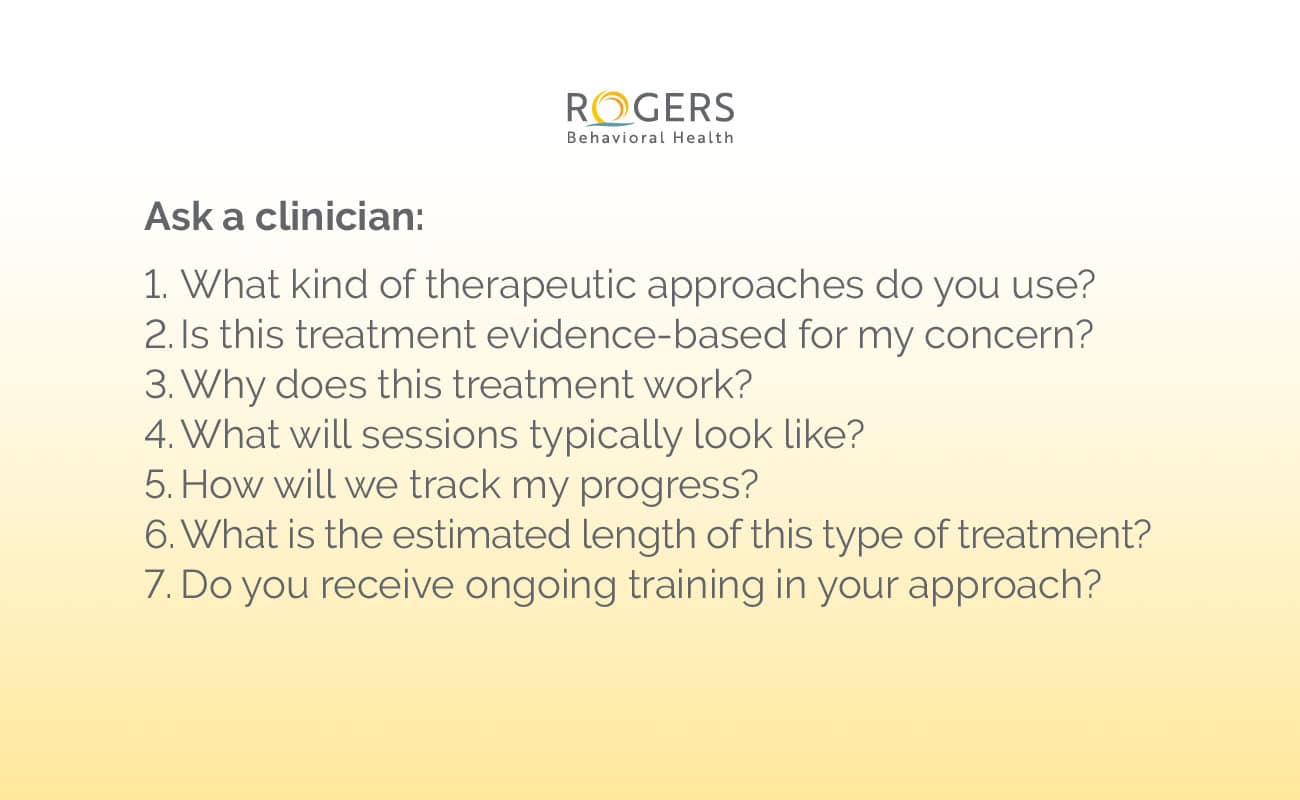
When seeking treatment for yourself or a loved one, I recommend asking the following questions:
- What kind of therapeutic approaches do you use?
- Is this treatment evidence-based for my concern?
- Why does this treatment work?
- What will sessions typically look like?
- How will we track my progress?
- What is the estimated length of this type of treatment?
- Do you receive ongoing training in your approach?
If a therapist’s answers don’t align with what you were hoping for, you can ask about alternative evidence-based approaches they use, clarify what you’re specifically looking for, or request more detail about the treatments they offer. Remember, you’re not being difficult—you’re advocating for your own mental health. Finding the right therapist can take time, and that’s okay. Think of it like going to a hair stylist who isn’t familiar with the style you want — you wouldn’t settle; you’d simply look for someone who can provide what you need.
What is the difference between evidence-based and measurement-based care?
Evidence-based care refers to the treatment approach which has been scientifically tested and proven to work. Measurement-based care is about tracking progress regularly to answer the question, “How do we know it’s working?” Rogers brings both approaches together, tailoring treatment to each individual, which gives them the strongest chance for success.
Rogers gathers ongoing feedback from the people we serve. We conduct approximately one million patient assessments each year—completed at the start of treatment, throughout treatment, at discharge, and again 12 months after care— to show that the progress made in treatment is maintained. We use those assessments to adjust our treatment as needed in real-time to help people achieve their goals. Additionally, sharing assessments with care teams across Rogers helps us understand what works best.
Rogers provides mental health and addiction treatment
At Rogers Behavioral Health, we combine compassionate care with methods backed by research to give the best chance for lasting recovery. If you’re ready to take the next step, our team is here to help.
Call 877-308-5887 to get started.
