
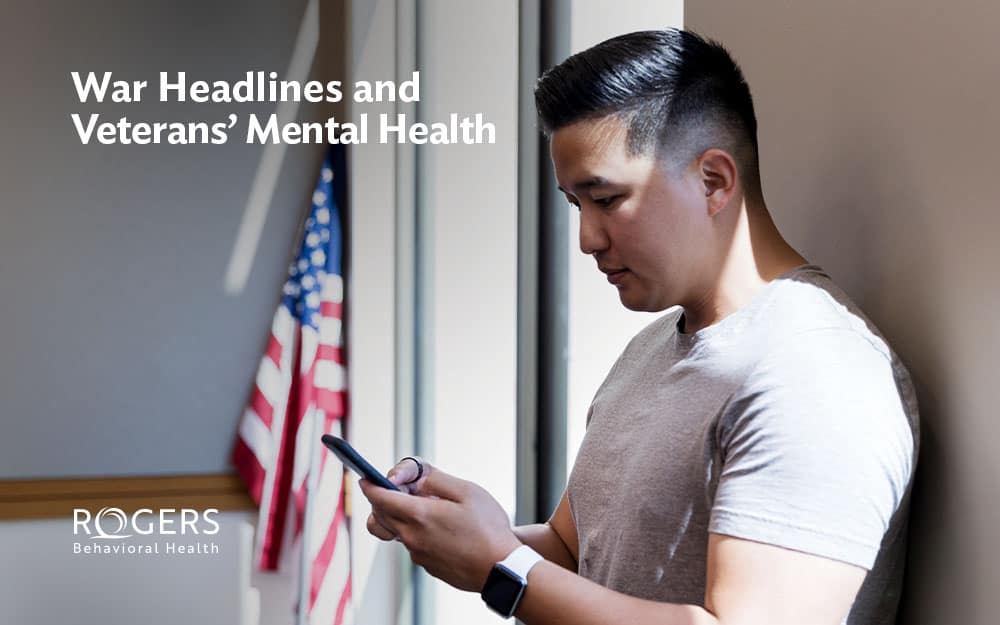
For many Veterans, news of war can stir more than concern. It can reopen difficult memories and emotions and bring them back to the surface.
Rogers Behavioral Health’s Joshua Deisinger, MS, LPC-IT, SAC-IT, therapist with Rogers’ Fire Watch program, and a medically retired Staff Sergeant from the United States Army, shares insights on how Veterans may respond to news coverage and offers ways they can cope.
How does news about war affect veterans’ mental health?
As an Iraq combat veteran, I understand well the psychological weight that we feel when our country engages in another war.
For many United States Armed Forces veterans, news of expanding conflicts in the Middle East, alongside ongoing wars in Afghanistan, Pakistan, and Ukraine, carries a burden that can be difficult to explain to those who haven’t experienced war firsthand.
How does military service impact veterans after they return home?
Military service leaves an imprint that doesn’t remain confined to the past. When new wars emerge, they often reopen spaces tied to memory, identity, and meaning. Headlines aren’t simply geopolitical updates. They can become reminders of places, sounds, decisions, and losses that were once part of daily life.
What signs might veterans notice when war news brings back past experiences?
Constant exposure to war coverage can reactivate memories connected to combat deployments, moral conflict, or the complex environments where the boundaries between right and wrong were rarely clear.
Veterans may notice:
- Heightened vigilance
- Shifts in mood
- Disrupted sleep
- Quiet return of questions that once felt settled
The mind naturally searches for connection and context, and global conflict can make past experiences feel suddenly present again. When these events unfold in familiar regions, they may also evoke a lingering sense that the sacrifices made there never truly concluded.
How can a sense of responsibility toward fellow service members resurface when new wars begin?
There’s often a deeper emotional layer beneath their reactions. Many veterans carry a lasting sense of responsibility toward those they served beside and the missions they carried out. When new wars begin, some feel a pull toward service again, while others experience frustration, grief, or moral tension as they watch history appear to repeat itself. For those who have spent years reconciling their experiences of war, renewed conflict can prompt reflection on purpose, cost, and whether the lessons of previous wars have truly been learned.
What perspective do veterans bring to war news?
When it comes to news coverage of war and global conflict, veterans often bring a perspective grounded in reality rather than rhetoric. Having witnessed the operational and human consequences of war firsthand, many veterans approach news of conflict with a sober understanding of what lies beneath political language and strategic framing. This awareness can bring both distance and clarity, along with a quiet empathy for those who will soon be asked to step into harm’s way.
How common is it for difficult thoughts or emotions to return when new conflicts arise?
The return of difficult thoughts or emotions in response to global conflict isn’t unusual. It reflects the lasting imprint of meaningful experiences rather than weakness.
How can veterans cope and find purpose when news of global conflicts brings back memories?
For many veterans, reflection becomes an opportunity to reconnect with values, community, and purpose beyond the battlefield. Conversations with fellow veterans, continued service to others, and acknowledging one’s own experiences can help place these reactions within a broader context of growth and resilience.
Why does war rarely feel fully “in the past” for those who have served?
Ultimately, when new wars emerge, veterans are reminded that war rarely stays in the past. Those who return from deployment often carry pieces of those experiences that can’t simply be set aside. They persist in memory, in present-day interpersonal relationships, and in the quiet bond shared with those who served beside them.
Learning to carry that reality while continuing to move forward is one of the enduring challenges of life after military service, and it is often intensified whenever new conflicts arise.
Rogers’ Fire Watch program
Rogers’ Fire Watch program is designed by Veterans. You’ll work with a team that understands and values your experiences and will be in treatment with others who share similar experiences.
The Fire Watch program treats:
- Moral injury due to witnessing or taking part in something that went against your values
- Survivor’s guilt and other challenging feelings around your service
- The effects of physical, mental, and sexual trauma
- Symptoms of depression and anxiety
- Other mental health conditions
Call 833-308-5887 for a free, confidential screening.
For many veterans, news about war can do more than inform, It can bring back difficult memories and emotions from their own service. Headlines may remind them of places, people, or experiences they lived through, making the past feel very present again.
Veterans may notice changes like trouble sleeping, feeling on edge, shifts in mood, or thinking more about past experiences. These reactions are common and reflect how deeply meaningful those experiences were. They are not a sign of weakness.
Talking with other Veterans, reconnecting with personal values, and finding ways to serve or support others can help. Acknowledging these feelings instead of pushing them away can also make it easier to process them and move forward toward your unique treatment plan. Each day, you will work with multiple members of our multidisciplinary team to ensure that you gain the skills and tools needed to overcome challenges.
