

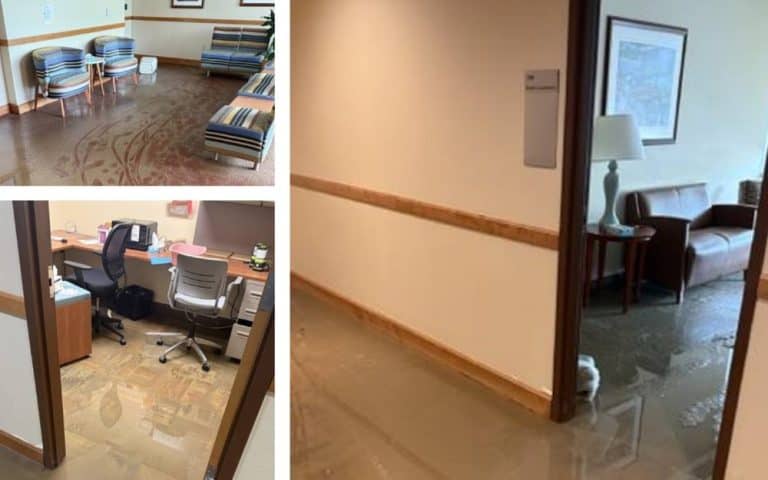
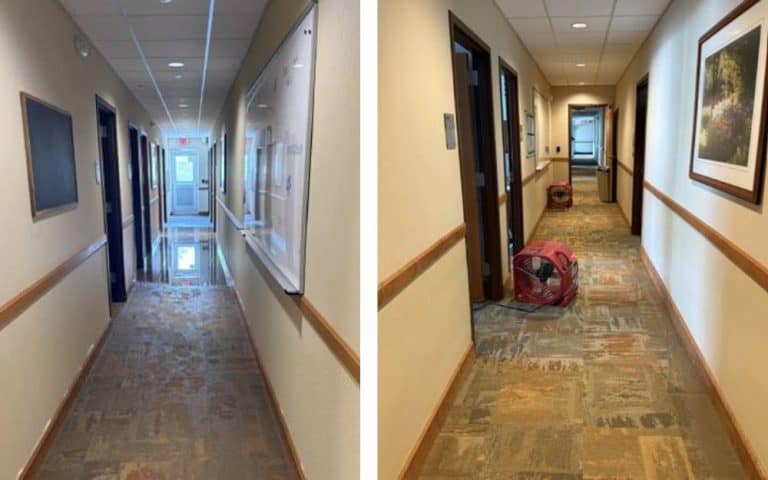
Good often emerges from unexpected challenges. That proved true at Rogers in Brown Deer, Wisconsin, where the Outpatient Center was impacted by historic flooding over the weekend of August 9 and 10. Despite causing significant disruption, the flooding also inspired teamwork and resilience.
“The street in front of the campus was flooded, and staff couldn’t get into the hospital, which is across from the clinic,” says September Casteel, vice president of operations, Brown Deer. “Dan Kessenich, our house supervisor, used one of our UTVs to pick up employees, which helped keep inpatient running.”
The Brown Deer leadership team called employees and every registered and scheduled patient to let them know that outpatient treatment would be moving to the hospital building.
Of the approximately 60 registered patients, they were able to reach 40, and all but one had planned to be there the next day.
“They were saying things like, ‘We will come through the floodwaters. We’ll do whatever we need to be there,’” she says.
Announcing a move is one thing but carrying it out is another. With several inches of dirty water in the clinic and no power, removing computers and other essentials by flashlight was no easy task.
“I worked alongside our manager of environmental services, Jeff Kruger, and VP of facilities, Barbara Whitstone, Sunday evening getting what was needed to treat patients the next day,” she explains. “We grabbed laptops, Relay Pro devices, and patient workbooks. Anyone who had a break in between patient care was there helping save whatever we could.”
September asked staff to meet at 7 am on Monday morning at the hospital for a briefing before welcoming patients at 7:45. Inpatient and residential team members worked tirelessly to move offices and combine spaces, making room for the PHP and IOP staff and patients.
“Initially, we were delivering treatment in the inpatient and residential spaces, and even in our cafeteria,” she explains. “We moved furniture, found equipment, chairs, and all the things.”
What felt impossible at first became manageable.
“We’re now capable of serving 80 PHP and IOP patients and staff in the hospital building,” she says. “It’s very tight and we’ve had to get creative, but we’re able to do it.”
The combined efforts of Brown Deer team members did not go unnoticed by patients.
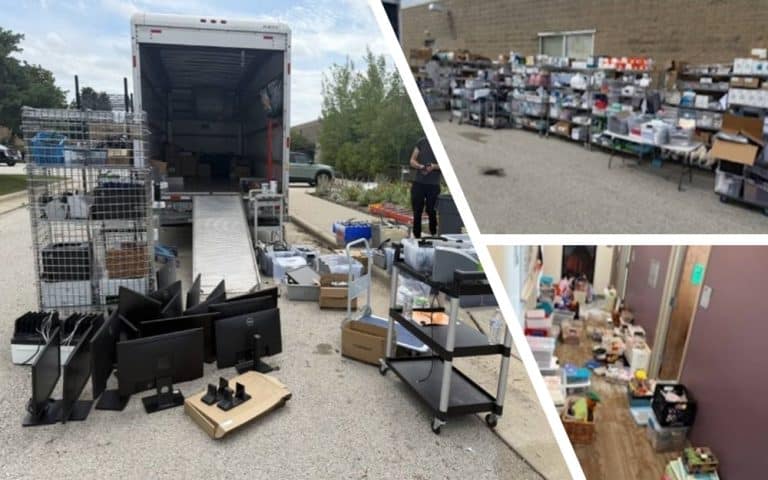
“They recognized what it took to keep treatment going and expressed their gratitude,” she says. “They were amazing. At one point, we had stuff saved from the clinic just stacked in the hallways because we didn’t have anywhere to go with it. Patients said things like, ‘We’re just so glad you’re here. Thank you for being here. You guys are doing amazing.’ It was so great to hear because I really think that helped all of us keep going when we were working ten- and 12-hour days.”
September says they couldn’t have done it with the help of ITS.
“They were a huge support, pulling out all the IT equipment that was savable from the clinic, including some of the team TVs, and setting up mobile bracket units so we could wheel them throughout the hospital and continue to provide virtual services as needed. They also helped us identify laptops so we could distribute them. ITS really came through for us.”
“It’s a privilege to work on a team where everyone is committed to our patients and staff, “ says Tyler Schramm, ITS Operations Supervisor. “Seeing everyone step in, adapt quickly, and support one another shows a kind of culture you can’t manufacture. September’s leadership was instrumental in keeping the pieces together!”
September says she always looks for a silver lining, and this situation is no exception.
“I want to thank the entire Brown Deer leadership team and staff who dropped everything to help,” she says. “I really think that it’s brought everyone together and allowed people in different levels of care to interact in a way that they wouldn’t have before.”
Currently, the building is being dried out, with plans for reconstruction expected to move forward soon.
“Everyone is being really accommodating and welcoming to each other,” she says. “Ultimately, patients will benefit as treatment teams grow closer through this experience.”
