
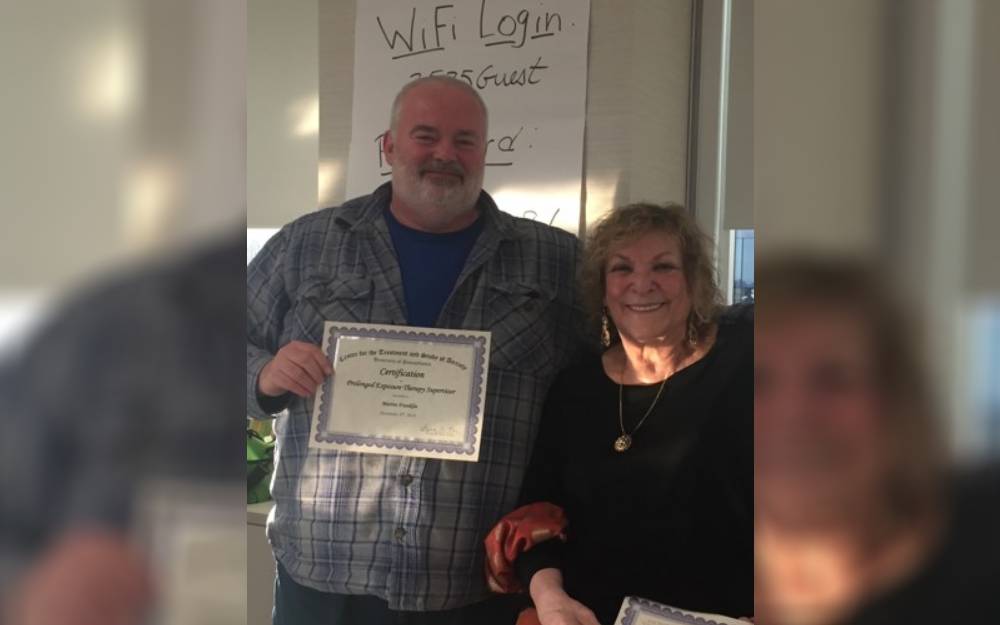
‘A tour de force, one of the pillars of our field’: Dr. Martin Franklin reflects on Dr. Edna Foa’s lasting legacy
Dr. Martin Franklin shared the reflection below offering a deeply personal perspective on Dr. Foa’s impact as a mentor, innovator, and force in behavioral health, and reminding us of the responsibility we carry to continue the work she advanced.
Got the news of Edna’s passing today, while I was delivering a training featuring some of her seminal work on OCD. Thought to myself that this was entirely fitting, and that Edna herself would most certainly encourage me to pull it together and finish strong, because the work is important enough for us to persist, regardless. I have so much to impart about this person who impacted the field in myriad ways, and was central to my own academic, clinical, and personal development. So many stories to share, but I will start with my first encounter with her work, and then with Edna herself.
In 1987 I was a grad student in experimental psych at Villanova. My mentor there was Doug Klieger, where his lab was studying the phenomenology and expression of anxiety. Doug was a man of very few words, but when he said them they mattered. He walked into my office one afternoon and placed a manuscript on my desk, tapped it twice, and said, “You’ll want to become familiar with this work.” It was “Emotional processing of fear: Exposure to corrective information,” by Foa & Kozak, Psych Bulletin, 1986. I knew Doug well enough to know what the double tap meant: you should learn this material inside-out and upside-down, so do your due diligence. And I did. Exposure works, but why? How? And for whom? I read it about 40 times, and began a process that would change my own life, as well as that of countless others treated with exposure-based therapies as well as the lives of those who provided such treatment. I didn’t know too much at 24, but I did know this that was important.
Fast forward to 1991, when I was applying for internships as I wrapped up my PhD studies at the University of Rhode Island, where I was also doing an externship at the PTSD clinic at the Providence VAMC, under the direction of Jim Curran, a graduate of the PhD program at the University of Illinois. Jim thought his grad school classmate who was now in Philadelphia would be an excellent mentor for me in my efforts to enter into academic research in anxiety & related disorders, so he wrote me a very strong letter specifically directed to his classmate. That classmate was Edna Foa.
Sometimes you know when you have reached the crossroads, sometimes you don’t. When I got the internship at the Medical College of Pennsylvania/Eastern Pennsylvania Psychiatric Clinic, I knew right away. My first rotation was through Edna’s clinic, and on my very first day she was hidden behind a huge stack of medical files as she prepared us for new cases. She slid the giant stack across the table to me and said, “Marty, is it? These are your new OCD cases.” I naively responded, “Thank you, Dr. Foa, but when will I receive the training to treat these cases?” She looked over at Michael Kozak, her right hand person, and shrugged her shoulders as if to say, “Where do we get these greenies?” She then looked into the depths of my soul, gestured to the pile and said, “Your training is in there.” But she paused for a sec, then added in response to my flummoxed expression, “But don’t worry, we’ll help you.”
Truer words have never been spoken. They did help me learn how to swim, albeit in the deepest end of the pool. Intensive group and individual supervision with these highly accomplished experts. Three consecutive intensive cases, one right after another, two hours a day, five days a week, for a month. I learned. I was challenged in a way I had never been before. And I quickly understood that I was sitting every day with luminaries, with people who would change the field for the better. Edna was a force: a brilliant theoretical mind, a tireless worker, and a mentor wholly invested in pushing you and making you better. Fully committed to that process. And wanted you to be as well.
Academic opportunities arose in addition to clinical ones: contributions to chapters, authorship on papers: all were available, but had to be earned. It took a lot of getting used to in the beginning, and trust earned meant more responsibility, which then needed to be juggled. We had endless theoretical discussions, some debates & disagreements, but all the while it felt like Edna was heavily invested in my future, and that I needed to match that same level of intensity. After a while I was asked to make even greater contributions, give more, take on more, learn more, teach more. Just more. I had never been driven so hard in my life, but when I looked at it objectively, I could see the progress. And the access to the world’s leading scholars stopping by for a week or three at a time.
Something had changed in me as I grew more comfortable in the role: it was the commitment to trying to make the lives of those who suffer better, but also to seed the field with knowledge about anxiety and its treatment. Edna had also assembled a team of like-minded scholars, researchers, and clinicians devoted to do the clinic’s work but also to find their own places to shine, and every opportunity was provided to make that happen. By the end of the 1990s I had transformed into our kid guy because that’s where the opportunities were, and with John March and his team at Duke and Henrietta Leonard and her team at Brown I was poised to develop my own programmatic line of clinical research. Edna invested thousands of hours into my training and learning, and though we did have our fair share of bare-knuckles boxing matches on a river barge (metaphorically speaking) I was given the room to grow. And disagree. All part of the process.
It took me a long time to realize that I was but one branch on Edna’s tree, and that she made the same kind of investment into the careers of countless other academics both at CTSA and outside of it. The math of that is just astounding: Edna took that work very seriously, and helped build the entire field on that foundation. Truly amazing, almost impossible if you really think about it.
Edna was a lot of things: brilliant, driven, deeply committed to the work, and to those who worked with her. She was also social, loved art and culture, loved classical music and gardening, was deeply committed to Charles and their family, but was also hysterically funny, and absolutely loved a good argument. Engaged. One of the most engaged people I have ever known. A tour de force, one of the pillars of our field. And my dear, true friend, who invested in me and saw talent in me that I did not recognize in myself until she aided me in doing so. My life of incredible good fortune was made all the better by her guidance, and by her refreshing directness which she knew I could handle. And benefit from. And thrive in. Thank you, Edna: I hope that the faith you placed in me felt worthwhile. I know I am better in so many ways because of it. Much love, and endless appreciation for the journey we took together.
-Dr. Martin Franklin
